Sawan (Shravan Maas)
The holiest month for Shiva — the month of the Sawan Somwar vrat, kanwar yatra and Rudrabhishek.
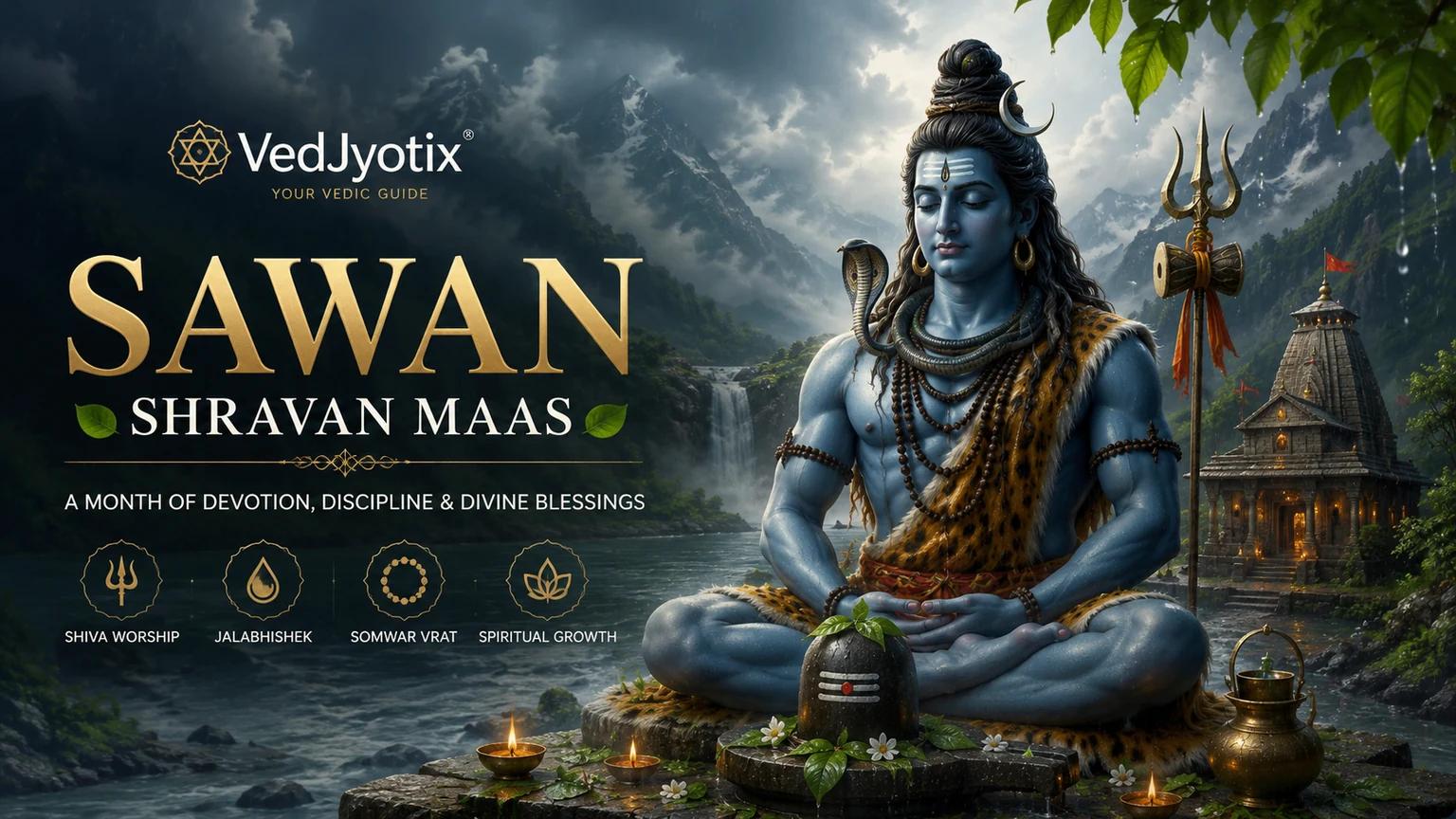
Sawan 2026
- North India · Purnimanta
- 30 July 2026 – 28 August 2026
- Amanta regions
- 13 August 2026 – 11 September 2026
- Sawan Somwar
- 4
- Sawan Shivratri
- 11 August 2026
The significance of Sawan
Shravan is the month of Shiva. It falls at the height of the monsoon, when the earth is green and the samudra manthan is remembered — Shiva drank the halahala poison in this season to save creation, and the month's water-offerings cool that burning throat. Every Monday is kept as a Sawan Somwar fast, and pilgrims carry Ganga water on foot (the kanwar yatra) to pour over the lingam.
Rituals of Sawan
- Sawan Somwar vrat every Monday
- Rudrabhishek and jalabhishek of the Shiva lingam
- The kanwar yatra — carrying Ganga water on foot
- Offering bel-patra, dhatura and white flowers
- Reciting the Shiva Chalisa and Mahamrityunjaya mantra
- Mangala Gauri vrat on Tuesdays for married women
How the Sawan Somwar vrat is kept
- The vrat is resolved (sankalp) on the morning of the Monday itself, after bathing and before the first offering — many say it aloud in front of the lingam or a picture of Shiva.
- Most keep a phalahar fast: one light meal, usually taken after the evening puja, with fruit, milk and water through the day. A nirjala (waterless) fast is the strictest form and is not expected of everyone.
- The Shiva puja is performed twice where practical — once after the morning bath and again at pradosh, the twilight window before and after sunset, which is considered the most auspicious hour of a Monday in this month.
- The fast is concluded (paran) after the evening puja and aarti, traditionally by first offering the food to Shiva and then eating it. Some conclude only the next morning; both practices are followed.
- Sixteen consecutive Mondays (Solah Somwar) is a separate, longer vow that many begin in this month rather than a rule of the month itself.
Fasting and vrat food
- Commonly taken: fruit, milk, curd, sabudana, singhara or kuttu flour, potatoes, rock salt (sendha namak), nuts and water.
- Commonly avoided: grains and lentils, ordinary table salt, onion and garlic, and meat, fish and eggs — many households avoid these for the whole month, not only on Mondays.
- Alcohol is avoided through the month by those observing it.
- Fasting is adapted freely. Children, older people, anyone pregnant or unwell, and anyone on medication customarily keep a lighter fast or none at all — the tradition treats this as ordinary, not as a failure of the vow. If you have a health condition, follow your doctor rather than a fasting rule.
Jalabhishek and puja vidhi
- Bathe before sunrise where you can, and face east or north for the puja.
- Offer the jalabhishek: pour water over the lingam in a slow, unbroken stream, chanting Om Namah Shivaya.
- Where it is the custom, follow with panchamrit — milk, curd, ghee, honey and sugar — and then rinse again with clean water.
- Offer bilva (bel) leaves with the smooth side facing down, along with dhatura, white flowers, bhang leaves, akshat and sandalwood paste.
- Light a ghee lamp and incense, offer the naivedya, and close with the aarti. Many read or listen to the Shiva Chalisa or the Somwar vrat katha before concluding.
Puja samagri
- Bilva (bel) leaves, ideally in sets of three
- Clean water, and Ganga jal where available
- Milk, curd, ghee, honey and sugar for panchamrit
- White flowers, dhatura and bhang leaves
- Akshat (unbroken rice), sandalwood paste, vibhuti
- Ghee lamp, incense, camphor
- Fruit and sweets for the naivedya
Observances through Sawan
- Sawan Somwar Vrat
- The Mondays of the month, kept for Shiva. The best known observance of Sawan and the reason the month is counted in Mondays rather than days.
- Mangla Gauri Vrat
- The Tuesdays of the month, kept for Parvati as Mangla Gauri — traditionally by married women for the wellbeing of the family, and by unmarried women seeking a good match.
- Kanwar Yatra
- Pilgrims (kanwariyas) carry Ganga water on foot, most visibly from Haridwar, Gaumukh and Sultanganj, to offer at a Shiva temple on Sawan Shivratri. Largest across Uttar Pradesh, Uttarakhand, Bihar, Jharkhand, Haryana and Delhi.
- Sawan Shivratri
- The Masik Shivaratri of this month, on the Krishna Chaturdashi. Night worship and jalabhishek are traditional, and it is the day most Kanwar Yatra offerings are made.
Do
- Offer water to the lingam daily through the month, even on days you are not fasting
- Keep the bilva leaves fresh and unbroken
- Read or listen to the Somwar vrat katha before concluding the fast
- Give food, clothes or water to someone who needs it — daan is part of the month
Avoid
- Do not offer tulsi leaves, ketaki flowers, turmeric or coconut water to the Shiva lingam
- Do not use a broken or torn bilva leaf
- Avoid starting the fast without sankalp if you intend to keep it as a vow
- Do not continue a fast that is making you unwell — conclude it and offer the puja instead
Regional traditions
- North India (Purnimanta)
- The month begins the day after Ashadha Purnima and ends on Shravana Purnima. Mondays are the principal vrat and the Kanwar Yatra is at its largest here.
- Maharashtra, Gujarat, Karnataka, Andhra Pradesh, Telangana, Tamil Nadu, Goa (Amanta)
- Shravana begins about fifteen days later, running new moon to new moon, so the Mondays counted as Shravan Somwar are a different set. Shravana Shanivar (Saturdays) and Mangala Gauri are widely kept alongside them.
- Tamil Nadu and Kerala
- The solar month Aadi overlaps Shravana. Aadi observances follow the solar calendar and do not track the lunar month boundaries used here.
- Nepal
- Shrawan follows the Bikram Sambat calendar; Mondays at Pashupatinath are the focus, and unmarried women commonly wear green bangles through the month.
Sawan dates by year
Sawan — Frequently Asked Questions
What is Sawan?
Sawan (Shravan Maas) is the fifth month of the Hindu lunar year and the one most closely associated with Lord Shiva. Falling in the monsoon, it is known for the Monday (Somwar) vrat, for jalabhishek of the Shiva lingam, and for the Kanwar Yatra.
Are Sawan and Shravan Maas the same?
They are the same month. Shravan Maas is its Sanskrit name and Sawan the everyday Hindi form of the same word — different names, not different periods.
Why do Sawan dates change every year?
Hindu months follow the moon, not the sun-based Gregorian calendar. A lunar year runs about 11 days shorter than a solar one, so Sawan arrives roughly 11 days earlier each year — except in a year with an adhika maas (an intercalary month), when it jumps about 19 days later instead.
Why does Sawan start on different dates in North and South India?
Two calendar systems. In Purnimanta (North India) a month ends on the full moon; in Amanta (Andhra Pradesh, Telangana, Goa, Maharashtra, Gujarat, Karnataka and Tamil Nadu) it ends on the new moon. That puts the start of Sawan about fifteen days earlier in the North. Festivals still fall on the same civil day in both, because they are fixed by tithi — it is only the month boundary that moves.
What is the Sawan Somwar vrat?
The vrat is resolved (sankalp) on the morning of the Monday itself, after bathing and before the first offering — many say it aloud in front of the lingam or a picture of Shiva. Commonly taken: fruit, milk, curd, sabudana, singhara or kuttu flour, potatoes, rock salt (sendha namak), nuts and water.
What is the Mangla Gauri vrat?
The Tuesdays of the month, kept for Parvati as Mangla Gauri — traditionally by married women for the wellbeing of the family, and by unmarried women seeking a good match.
What is the Kanwar Yatra?
Pilgrims (kanwariyas) carry Ganga water on foot, most visibly from Haridwar, Gaumukh and Sultanganj, to offer at a Shiva temple on Sawan Shivratri. Largest across Uttar Pradesh, Uttarakhand, Bihar, Jharkhand, Haryana and Delhi.