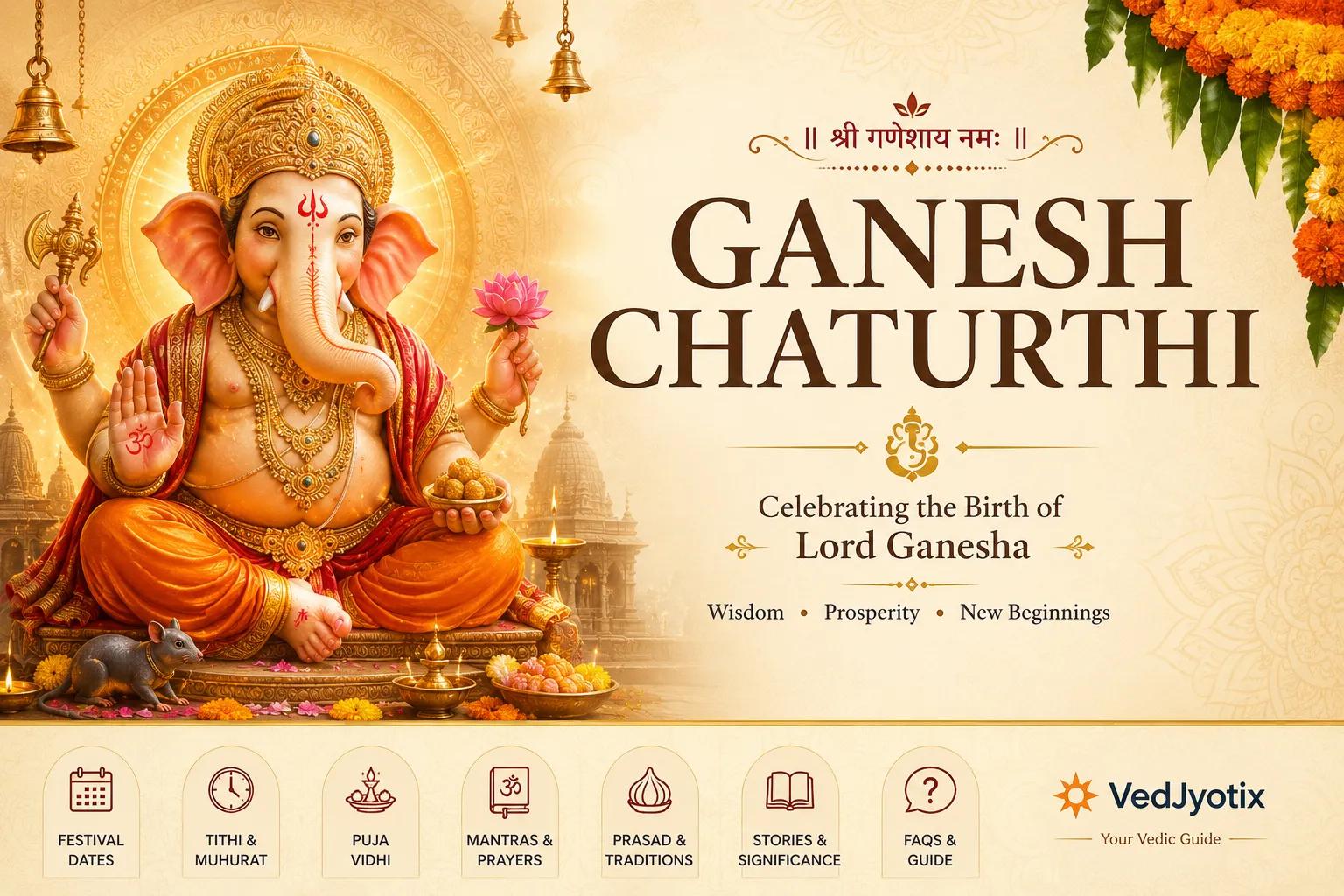
Ganesh Chaturthi
Ganesha's installation on Bhadrapada Shukla Chaturthi; ten days to Anant Chaturdashi.
Ganesh Chaturthi 2027
The next Ganesh Chaturthi falls on Saturday, 4 September 2027. The year page carries that day's tithi timings, puja muhurat and the Ganesh Visarjan (Anant Chaturdashi) date.
Ganesh Chaturthi 2027 — full date & muhuratToday's Panchang
Kashi reference · computed live- Tithi
- Navami
- till 17:50
- Nakshatra
- Purva Ashadha
- till 04:31
- Yoga
- Saubhagya
- Karana
- Kaulava
- Sunrise
- 05:45
- Sunset
- 17:57
- Moon sign
- Sagittarius
- Sun sign
- Virgo
Muhurat & timings
Kashi/IST · astronomically computed- Sankalp (sunrise)05:39
- Madhyahna puja muhurat10:42 – 13:13
- Fasting window (tithi)2027-09-03 · 14:20 → 12:27
- Parana (tithi ends)12:27
When Ganesh Chaturthi falls
| 2025 | Wednesday, 27 August 2025 |
| 2026 | Monday, 14 September 2026 |
| 2027 | Saturday, 4 September 2027 |
| 2028 | Wednesday, 23 August 2028 |
| 2029 | Tuesday, 11 September 2029 |
Dates are computed astronomically against Kashi sunrise.
The significance of Ganesh Chaturthi
Ganesh Chaturthi falls on the Shukla Chaturthi of Bhadrapada and marks Ganesha's birth. He is Vighnaharta, the remover of obstacles, and also Vighnakarta, the one who places them — the same power, used to test whether an undertaking deserves to proceed. No rite, journey or venture begins without invoking him first.
The puja is performed in madhyahna kaal, the midday window, because Ganesha is held to have been born at noon. The idol is installed for a fixed number of days — one and a half, three, five, seven or ten — and then immersed. The immersion is not a discarding but the point of the whole observance: what is welcomed with full ceremony is also released, and the clay returns to the water it came from.
On this night, custom holds that the moon should not be looked at. Seeing it is said to bring mithya dosha — a false accusation.
Mythology & origins
Parvati made a boy from the turmeric paste of her own body and set him to guard her door while she bathed. When Shiva returned and the boy — not knowing him — barred the way, Shiva struck off his head. Seeing Parvati's grief, Shiva sent his ganas to bring the head of the first creature they met facing north; it was an elephant, and with it the boy was revived as Gajanana, lord of Shiva's hosts, first to be worshipped before any rite. A second story explains the Chaturthi moon-taboo: the moon laughed at Ganesha's fall from his mount, and was cursed, so seeing it on this night is said to bring a false accusation (mithya dosha).
Seasonal & scientific significance
Ganesh Chaturthi falls in Bhadrapada, still within the monsoon — the reason the idol is traditionally of unbaked river clay and is returned to water at visarjan. The observance is a full ecological cycle: clay is taken from the water, given form and worship for a day and a half to ten days, and dissolved back. The madhyahna (midday) timing follows the tradition that Ganesha was born at noon.
Spiritual significance
Ganesha is Vighnaharta, remover of obstacles, and equally Vighnakarta, the one who places them — the same power that clears the path can also block it, to test whether the undertaking deserves to proceed. That is why no rite begins without invoking him. And the visarjan is the point, not a discarding: what is welcomed with full ceremony is also released, and the clay returns to the water it came from — devotion held, then let go.
Ganesh Chaturthi puja vidhi
- 1Bathe, wear clean clothes, and prepare the platform with a clean cloth before madhyahna kaal.
- 2Install the idol facing east or north. Sprinkle water, and perform pranapratishtha — invoking the deity into the image.
- 3Offer durva grass in twenty-one blades, red hibiscus, sandal paste, akshat and kumkum.
- 4Offer twenty-one modaks, or as many as can be made. Modak is his portion; nothing substitutes for it.
- 5Recite the Ganapati Atharvashirsha or the Sankatnashan Ganesh Stotra, then perform aarti.
- 6Repeat aarti morning and evening for as many days as the idol is kept.
- 7On the final day, offer a farewell puja, ask forgiveness for lapses in the observance, and immerse the idol in water.
Puja samagri — what to gather
- A clay (mitti) idol of Ganesha
- Durva grass (in bunches of 21 blades)
- Red hibiscus and flowers
- Modak — steamed or fried
- Sandal paste, kumkum, akshat
- A whole coconut and bananas
- A janeu (sacred thread) for the deity
- Panchamrit
- Incense, camphor and a diya
- Betel leaf and nut
Mantra
ॐ गं गणपतये नमः
Om Gam Ganapataye Namah
Salutations to Ganapati, lord of beginnings and of obstacles.
Vrat rules
- The fast, where kept, runs until the midday puja and is broken with the modak prasad.
- Many families keep no fast at all and observe the festival through the puja and the daily aarti instead.
- Do not look at the moon on Chaturthi night; if seen inadvertently, the Syamantaka katha is recited as remedy.
- The idol should be of unbaked clay, without chemical paint, since it will be returned to water.
- Once installed, the idol is not left alone: aarti is performed morning and evening until visarjan.
Vrat food — what to eat and avoid
Allowed
- Modak — his portion; twenty-one where possible
- Motichoor and besan laddu
- Karanji and puran poli
- Coconut, jaggery and fruit
- Sattvic vegetarian bhog shared as prasad
Avoided
- Those who fast avoid grains until the midday puja
- Onion and garlic in the bhog
- Non-vegetarian food and alcohol during the days the idol is home
- Looking at the moon on Chaturthi night
The vrat katha of Ganesh Chaturthi
Parvati, wishing to bathe undisturbed, formed a boy from the turmeric paste of her own body and gave him life, telling him to let no one pass. When Shiva returned and was stopped at his own door, he struck the boy's head from his shoulders. Parvati's grief turned to a fury that threatened creation itself, and she would accept nothing but her son restored.
Shiva sent his ganas north with an instruction: bring the head of the first creature they found sleeping with its head to the north. They returned with the head of an elephant. It was placed on the boy, and he rose. Shiva then gave him a boon that Parvati's anger could not have won by force — that he would be worshipped before all other gods, at the beginning of every undertaking, for as long as any rite was performed anywhere.
How it differs by region
Maharashtra
The grand form: home and public pandal idols for one and a half to ten days, revived as a public festival by Lokmanya Tilak in 1893; Lalbaugcha Raja and the great visarjan processions.
Goa
Chavath — the matoli, a canopy of forest produce hung above the idol, and family idols brought with strict ritual purity.
South India
Vinayaka Chavithi — clay idols, kozhukattai (the Tamil modak) and worship with twenty-one kinds of leaves (patra).
Telangana & Andhra
Khairatabad's towering idol and lake immersions; puja with 21 patri and undrallu offered.
Common questions
Why should the moon not be seen on Ganesh Chaturthi?
The moon mocked Ganesha and was cursed that whoever looked at it on this tithi would face a false accusation. Krishna himself was said to suffer it in the Syamantaka jewel episode; reciting that story is the prescribed remedy.
How many days should the idol be kept?
One and a half, three, five, seven or ten days — all are valid. What matters is that aarti is performed each day and the visarjan is done as promised at installation.
What is offered to Ganesha?
Durva grass in twenty-one blades, red flowers, and modak. Modak is his particular offering and is not substituted.
Other festival guides
- Makar Sankranti
- Vasant Panchami
- Maha Shivaratri
- Holika Dahan
- Holi
- Chaitra Navratri begins
- Gudi Padwa / Ugadi
- Ram Navami
- Hanuman Jayanti
- Akshaya Tritiya
- Buddha Purnima
- Vat Savitri Vrat
- Ganga Dussehra
- Nirjala Ekadashi
- Jagannath Rath Yatra
- Devshayani Ekadashi
- Guru Purnima
- Hariyali Teej
- Nag Panchami
- Raksha Bandhan
- Kajari Teej
- Krishna Janmashtami
- Hartalika Teej
- Radha Ashtami
- Anant Chaturdashi
- Pitru Paksha begins
- Sharad Navratri begins
- Durga Ashtami
- Maha Navami
- Dussehra / Vijayadashami
- Sharad Purnima
- Karwa Chauth
- Ahoi Ashtami
- Dhanteras
- Naraka Chaturdashi (Choti Diwali)
- Diwali (Lakshmi Puja)
- Govardhan Puja
- Bhai Dooj
- Chhath Puja
- Devutthana Ekadashi
- Kartik Purnima (Dev Deepawali)
- Guru Nanak Jayanti
- Gita Jayanti
- Mauni Amavasya
- Baisakhi (Mesha Sankranti)
- Vishwakarma Puja
Get ready for Ganesh Chaturthi
Festival toolkit
Puja checklist
Tick items as you gather them — saved on this device.
Wishes to share
Quotes
“Vakratunda Mahakaya — where Ganesha is remembered first, no work goes undone.”
“He rides a mouse and moves mountains; smallness is no bar to greatness.”
Ganesh Chaturthi timings by city
Timings are computed astronomically for each city's own coordinates and timezone.
Explore around this festival
Timing for this day
Timings by city
Related festivals
Explore more
Still have questions?
Ask Tara — grounded answers about Ganesh Chaturthi, in your language.
- Can unmarried girls observe the Ganesh Chaturthi vrat?
- Can pregnant women perform the Ganesh Chaturthi puja?
- Why is the Ganesh Chaturthi date different in Maharashtra?
- What mantra should I chant for Ganesh Chaturthi?
- What time should I perform the Ganesh Chaturthi puja in my city?